
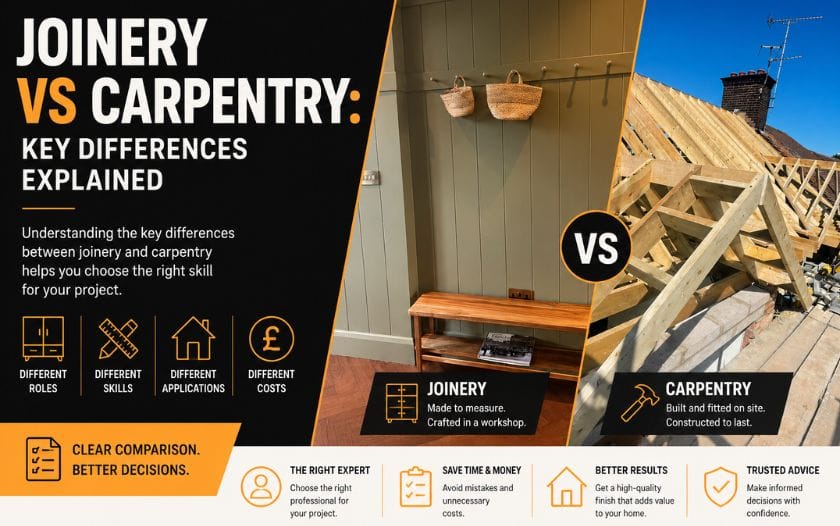
One of the most common questions homeowners ask us is whether they need a joiner or a carpenter. Although both trades work with timber, they do very different jobs, and getting the joinery vs carpentry decision right can have a big impact on the success of your project.
Whether you’re fitting a new kitchen, installing built-in wardrobes, creating bespoke storage, or carrying out a wider home improvement project, understanding the difference helps you avoid unnecessary costs and ensures you get the right expertise from the start.
At North London Joinery, we regularly help homeowners understand whether their project needs bespoke joinery, carpentry, or a combination of both before any design or installation work begins.
Understanding Bespoke Joinery
Bespoke joinery involves creating made-to-measure wooden features that are individually designed and manufactured to suit the exact size, layout, and style of your home. Rather than using standard-sized products, every piece is carefully planned and crafted to meet your specific requirements, resulting in a seamless fit and a finish that reflects your personal taste.
Common bespoke joinery projects include fitted wardrobes, bespoke kitchens, built-in cupboards, media walls, alcove shelving, home office furniture, under-stair storage, and custom bookcases. It can also be used to create bespoke staircases, window seats, timber panelling, and other made-to-measure wooden features.
Understanding Carpentry
Carpentry is the skilled trade of constructing, fitting, repairing, and installing timber structures and wooden components within a property. Unlike bespoke joinery, which focuses on manufacturing made-to-measure timber products, carpentry mainly involves working on-site to install, construct, and repair timber features.
Common carpentry projects include door installation, skirting boards, architraves, timber flooring, staircases, roof structures, stud walls, decking, and general wood repairs. Carpenters play an essential role in both new builds and renovation projects, ensuring wooden features are accurately fitted, durable, and built to a high standard.
From our experience, many homeowners use the terms “joiner” and “carpenter” interchangeably. During site visits, one of the first things we explain is that the right trade depends on the work involved. Once we understand whether a project requires bespoke manufacturing, on-site installation, or both, recommending the right approach becomes much clearer.
What is the Difference Between Carpentry and Joinery?
The difference between a carpenter and a joiner is that a joiner designs and manufactures bespoke wooden products in a workshop, while a carpenter installs, constructs, and repairs timber features on-site. A joiner focuses on creating made-to-measure woodwork, whereas a carpenter specialises in fitting and assembling those components within a property.
| Aspect | Joiner | Carpenter |
| Work Location | Works mainly in a workshop, where bespoke timber products are designed and manufactured. | Usually works on-site, fitting, assembling, and repairing timber features. |
| Primary Role | Designs and manufactures bespoke wooden products to exact specifications. | Installs, constructs, and repairs timber structures and wooden fixtures. |
| Type of Work | Produces custom-made woodwork using precision craftsmanship before installation. | Fits, assembles, and finishes timber elements during construction or renovation projects. |
| Common Projects | Creates fitted closets, bespoke kitchens, media walls, staircases, cabinetry, and other custom furniture. | Installs doors, skirting boards, timber flooring, roof structures, stud walls, decking, and staircases. |
| Tools Used | Uses specialist workshop machinery and precision woodworking tools. | Uses portable hand and power tools for on-site installation and repairs. |
| Customisation | Creates fully bespoke pieces tailored to the property’s exact dimensions and style. | Adapts and installs timber products to suit the building and project requirements. |
| Project Stage | Manufactures timber components before they are delivered for installation. | Installs and finishes manufactured timber components on-site. |
| Best For | Ideal for bespoke furniture, made-to-measure storage, custom cabinetry, and other made-to-measure features. | Ideal for structural timber work, renovations, and installing wooden fixtures and fittings. |
From our experience, it’s common for homeowners to be unsure whether their project requires bespoke joinery or carpentry services. We’ve found that the best recommendation only comes after assessing the property’s layout, the type of timber work involved, and how the project will be completed. This approach helps avoid unnecessary work and ensures the right trade is involved at the right stage.
When Should You Hire a Joiner or a Carpenter?
You should hire a joiner when your project requires bespoke, made-to-measure wooden products such as built-in wardrobes, custom kitchens, or built-in storage. You should hire a carpenter when you need timber structures, doors, flooring, staircases, or other wooden features installed, repaired, or constructed on-site. The right choice depends on the type of work your home improvement project involves.
You should hire a joiner if you need:
- Fitted wardrobes that maximise storage and fit your room perfectly.
- Bespoke kitchens with custom-built cabinets and units.
- Built-in storage, alcove shelving, or media walls made to your exact specifications.
- Custom furniture, including bookcases, window seats, and home office furniture.
- Made-to-measure wooden features that require expert craftsmanship and a smooth finish.
You should hire a carpenter if you need:
- Doors, skirting boards, and architraves professionally fitted.
- Timber flooring installed or repaired.
- Roof structures, stud walls, or structural timber work for construction or renovations.
- Staircase installation or repairs as part of a home improvement project.
- Decking, timber repairs, or general on-site woodwork that requires fitting and construction.
We’ve found that many projects involve both trades. A bespoke wardrobe, media wall, or kitchen, for example, is usually manufactured first before being professionally installed on-site. Understanding how custom joinery services and on-site carpentry work together helps avoid confusion and ensures the right skills are used at each stage.
What We Look at Before Recommending a Joiner or Carpenter?
Every home improvement project is different, so we don’t recommend a joiner or a carpenter based on the type of room alone. Before making a recommendation, we assess how the work will be carried out, whether bespoke timber components need to be manufactured, and what the property itself requires. These practical considerations help us recommend the most suitable approach rather than the most expensive one.
1. Property Layout
Awkward alcoves, sloping ceilings, chimney breasts, narrow hallways, or uneven walls often require bespoke joinery because standard products rarely fit properly. If the work mainly involves installing timber features into an existing space without custom manufacturing, carpentry may be the more suitable option.
2. Existing Timber Features
We look at the condition of any existing timber that forms part of the project. Doors, staircases, skirting boards, flooring, or built-in furniture may be suitable for repair, modification, or integration into the new design rather than complete replacement. Understanding what can be retained often helps reduce unnecessary work and keeps the finished project consistent with the rest of the property.
3. Structural Work Required
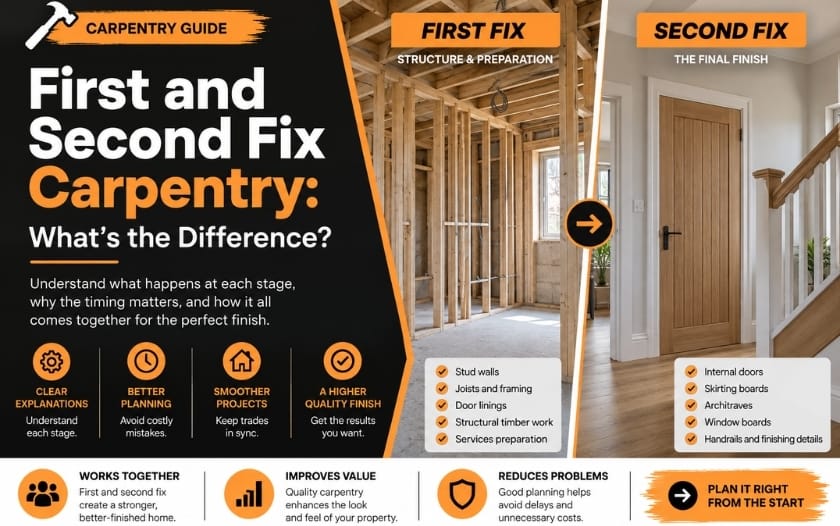
Some projects involve removing walls, altering structural timber, building stud partitions, or installing roof timbers require on-site carpentry before any bespoke joinery can be installed. Identifying these requirements early helps ensure the work is completed in the correct sequence and avoids delays later in the project.
4. Workshop Manufacturing or Site Installation
One of the biggest deciding factors is where the work needs to happen. If the project involves made-to-measure wardrobes, custom cabinets, media walls, or fitted storage, these elements are usually manufactured in a workshop before being installed on site. This is the process we follow for many bespoke joinery & fitted furniture in London projects, ensuring every piece is manufactured to the exact dimensions of the property before professional installation. Projects that mainly involve fitting doors, flooring, skirting boards, or other timber features are generally completed through on-site carpentry.
5. Homeowner Priorities
We always ask how the space will be used before discussing materials or finishes. Some homeowners want to maximise storage in a smaller room, others want furniture that complements the character of their property, while some are focused on creating a practical family living space. Understanding these priorities helps shape the recommendation and ensures the finished work suits how the home is used every day.
6. Access for Materials and Installation
We also consider whether large timber components can be safely brought into the property. Narrow hallways, tight staircases, or loft conversions sometimes require joinery to be manufactured in smaller sections before being assembled on site.
7. Budget & Long-Term Plans
Budget is important, but we also consider your long-term plans for the property. If you’re renovating your forever home, investing in bespoke joinery may provide better long-term value and functionality. If the work forms part of a larger renovation or extension, we may recommend completing structural carpentry first so custom joinery can be designed and installed once the space is finalised.
From our experience, the best results come from assessing the property before deciding which trade is needed. We’ve found that understanding the layout, existing structure, and how the homeowner intends to use the space usually leads to a better recommendation than simply choosing a joiner or carpenter based on the project title.
We recently completed a bespoke joinery project in Forestdale, Southgate, where we designed and installed made-to-measure storage that maximised the available space while complementing the property’s existing features. You can explore our recent joinery projects to see how bespoke storage, fitted furniture, and other made-to-measure solutions are designed, manufactured, and installed in real homes.
So, What Should You Choose?
Most projects don’t fall neatly into one category or the other. If you’re fitting a wardrobe into an awkward alcove, replacing a run of kitchen cabinets, or want furniture built around an odd-shaped room, that’s joiner territory. The work needs designing and manufacturing to match your exact space, which isn’t something you can do with off-the-shelf products.
If you’re dealing with doors, skirting, flooring, staircases, or structural timber, that’s a carpentry job, fitted, repaired, or built on-site rather than made in a workshop first. Where it gets less obvious is anything involving both. A loft conversion might need stud walls and structural timber before any bespoke storage goes in. A kitchen renovation often needs a carpenter to sort the flooring and a joiner to build the units. We’d rather walk the property with you and work out the sequence than have you try to guess it from a brief.
That’s really the heart of the joinery vs carpentry question, it’s less about which trade sounds right for the room, and more about what the work actually involves once someone’s stood in the space and looked at it properly.
If you’re still not sure, that’s normal. Send us a few photos, or get a free quote, and we’ll tell you straight whether you need a joiner, a carpenter, or both and in what order.
If you’d rather talk it through first, you can always contact us, and we’ll point you in the right direction before anything’s booked in.
Frequently Asked Questions
Bespoke joinery is ideal for projects that require made-to-measure wooden features designed to fit a specific space. Common projects include fitted wardrobes, bespoke kitchens, built-in storage, media walls and alcove shelving.
No, a joiner and a carpenter are closely related trades, but they are not the same. Both are skilled woodworking professionals, however, a joiner specialises in designing and manufacturing bespoke wooden products, while a carpenter focuses on installing, constructing, and repairing timber features on-site.
Sometimes bespoke joinery costs more because it involves custom design and manufacturing, but the overall cost depends on the project’s complexity, materials, and installation requirements.
You typically need a joiner for a kitchen renovation if you’re installing bespoke cabinets, custom storage, or made-to-measure kitchen units. A carpenter is required to install timber features such as doors, flooring, skirting boards, and other on-site woodwork. For a complete kitchen renovation, both a joiner and a carpenter work together to achieve the best result.
Yes, some carpenters can carry out certain joinery-style tasks, but bespoke joinery typically requires specialist workshop manufacturing and precision craftsmanship. For made-to-measure wardrobes or custom storage, a professional joiner is usually the better choice, while carpenters specialise in on-site installation, structural timber work, and fitting timber features.
Bespoke joinery projects generally take longer than carpentry because they involve design, manufacturing, and installation. Smaller bespoke joinery projects may take 2–4 weeks, while larger projects can take several weeks depending on complexity.


0 Comments