Homeowners often notice the signs that something needs attention long before they know what the right solution is. A staircase that creaks a little more each year, doors that no longer close properly, worn skirting boards, damaged timber, or ageing woodwork can all affect how your home looks and functions. The difficulty is knowing whether these issues need a simple repair, a larger improvement, or professional carpentry work.
Minor timber damage can become more extensive, everyday wear can turn into costly repairs, and small fitting issues can affect the comfort and usability of your home. With so much conflicting advice online, it can also be difficult to understand what home carpentry includes, which projects are worth investing in, and how to plan the work properly.
At North London Joinery, we’ve helped homeowners through our joinery services in London by assessing properties individually rather than relying on one-size-fits-all recommendations. Every home has its own layout, timber condition, and practical requirements. This guide explains what home carpentry is, the different types of carpentry work, common projects, planning considerations, and the key factors to understand before starting any improvements.
What Is Home Carpentry?
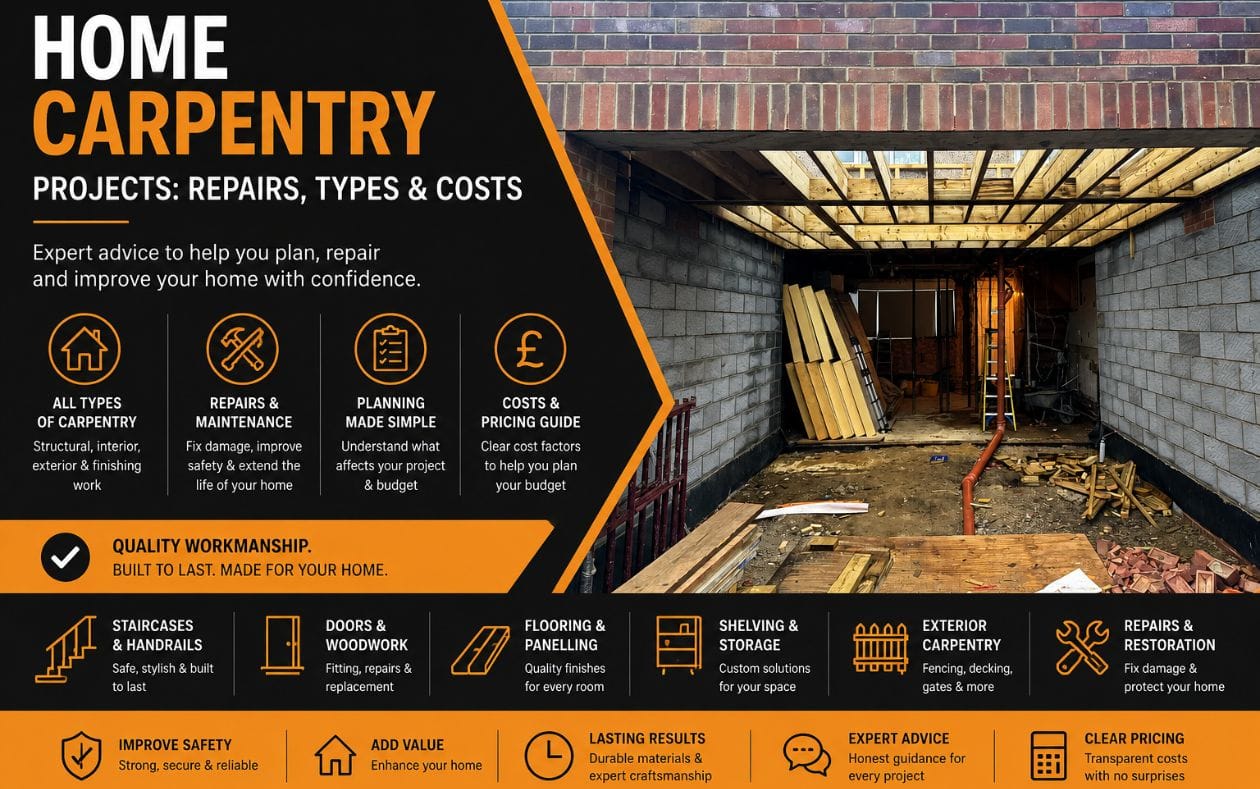
Home carpentry is the construction, installation, repair, and maintenance of wooden features within and around a home. It includes work such as fitting internal doors, staircases, skirting boards, flooring, wall panelling, timber framing, and repairing or replacing damaged woodwork to improve a property’s functionality, safety, and appearance.
Home carpentry covers a wide range of work, from minor repairs that extend the life of existing timber to larger improvements completed during renovations, extensions, or loft conversions.
Whether you’re repairing worn timber or planning a larger improvement, the first job is understanding what you’re working with. Existing timber condition, measurements, movement in the property and the way the finished space needs to function can all affect the right approach. Larger or more involved projects may also benefit from our professional carpentry services, particularly where accurate fitting, repairs and new timber work need to be planned together.
What Does a Home Carpenter Do?
A home carpenter works with timber to repair, replace, install, and maintain the wooden features that keep a property safe, practical, and visually appealing. Their work includes fitting internal doors, staircases, skirting boards, flooring, wall panelling, timber framing, and carrying out repairs that help extend the life of existing woodwork.
In practice, the success of a carpentry project often depends on the planning that takes place before any timber is cut. We assess the property’s layout, take accurate measurements, inspect the condition of the existing woodwork, and consider factors such as structural movement, moisture, access, and the intended use of the space.
Types of Home Carpentry
Home carpentry can generally be divided into structural, finishing, interior, exterior, and repair work. These areas cover everything from supporting timber structures and interior finishing to outdoor timber features and repairs to existing woodwork.
1. Structural Carpentry
Structural carpentry includes timber elements such as floor joists, roof structures, framing and parts of staircases that contribute to the strength and stability of the property. This is an area where we wouldn’t make assumptions from what can be seen on the surface. Existing movement, previous alterations and the condition of supporting timber may all need to be checked before deciding whether repair, strengthening or replacement is appropriate.
2. Finish Carpentry
Finish carpentry covers the visible timber details that complete a room, including internal doors, skirting boards, architraves, handrails and mouldings. This is the sort of work where small fitting errors are easy to notice. Uneven walls, out-of-square door openings and changes in floor level can all affect the final result, so we normally work from the actual room rather than assuming everything is perfectly level or square.
3. Interior Carpentry
Interior carpentry includes timber work inside the home such as shelving, wall panelling, flooring, room partitions and staircase improvements. The existing layout usually tells us more than a drawing alone. Before recommending anything, we’d look at how the room is used, where doors, radiators and sockets sit, how much usable space is available and whether the proposed work could make everyday movement or storage more difficult.
4. Exterior Carpentry
Exterior carpentry covers timber features exposed to weather, such as gates, decking, external doors, cladding and other outdoor structures. With exterior timber, the condition of the finish is only part of the picture. We’d also look for trapped moisture, end-grain exposure, movement around fixings, and areas where water tends to sit, because repairing the visible damage without addressing the cause can lead to the same problem recurring.
5. Repair Carpentry
Repair carpentry focuses on restoring worn or damaged timber where replacement isn’t necessary. A loose floorboard, sticking door or cracked section of timber doesn’t automatically mean the whole feature needs replacing. We’d first look at what caused the problem, how far the damage has spread and whether the surrounding timber is still sound enough to make a lasting repair worthwhile.
Common Home Carpentry Projects
The most common home carpentry projects include fitting internal doors, installing staircases, laying timber flooring, repairing damaged woodwork, fitting skirting boards and architraves, building timber partitions, and upgrading interior or exterior timber features.
1. Internal Doors
A door that sticks, catches or won’t close properly doesn’t automatically need replacing. We’d first look at the hinges, frame alignment, clearances and whether movement or moisture has affected the timber.
If a new door is needed, the existing opening matters just as much as the door itself. Older frames aren’t always perfectly square, so accurate measuring and fitting can make the difference between a door that operates properly and one that starts catching again.
2. Staircases
A squeaking staircase doesn’t necessarily mean there’s a serious problem, but movement, loose components, or worn joints should be checked before deciding what needs repairing. Carpentry work may involve repairing worn components, replacing damaged sections, or upgrading the staircase to better suit the property’s style.
3. Timber Flooring
Timber flooring adds warmth and durability to living spaces, but it needs accurate preparation and installation to achieve a long-lasting finish. Depending on its condition, existing flooring can sometimes be repaired or restored instead of being completely replaced.
4. Skirting Boards & Architrave
Skirting boards and architraves create clean transitions between walls, floors, doors, and windows and protect surfaces from everyday wear. Updating these details is a simple way to refresh a room and achieve a more consistent finish throughout the property.
5. Shelving & Media Walls
Shelving and media walls can help organise living spaces by providing practical storage and dedicated areas for televisions, equipment, books, and everyday items. The layout needs to consider wall dimensions, sockets, cables, ventilation, and how the room will actually be used before installation begins.
6. Wall Panelling & Timber Features
Wall panelling and other decorative timber features add character and depth to interior spaces without changing the overall layout of the room. Selecting the right design and proportions helps these features complement both traditional and contemporary homes.
7. Timber Repairs
Timber naturally ages over time, and issues such as cracks, rot, loose joints, or general wear don’t always require complete replacement. In many situations, repairing existing timber can restore its strength and appearance, helping preserve the property’s character and reduce unnecessary costs.
How to Know If You Need a Home Carpenter?
You may need a home carpenter if your property has worn, damaged, or poorly functioning wooden features that require professional attention. Common signs include sticking doors, squeaking staircases, uneven flooring, loose trim, or woodwork that has deteriorated through age, moisture, or everyday use.
- Internal doors that stick, catch, or won’t close properly
- Squeaking, loose, or unstable staircases
- Cracked, warped, or uneven timber flooring
- Loose or damaged skirting boards and architraves
- Rot, moisture damage, or decaying woodwork
- Worn window frames or external doors
- Damaged decking, fencing, pergolas, or other outdoor timber structures
- Gaps, movement, or general wear in wooden features
- Existing woodwork that could be repaired instead of replaced
- Timber elements that need upgrading during a renovation or home improvement project
Based on our experience, many of these issues develop gradually and are easy to overlook until they begin affecting the comfort, appearance, or functionality of a home. Identifying the cause early allows the most appropriate repair or improvement to be carried out before more extensive work becomes necessary.
What to Consider Before Starting a Home Carpentry Project?
Before starting a home carpentry project, it’s important to assess the property’s condition, understand how the space will be used, choose suitable materials, and identify any structural or practical factors that could affect the work.
1. The Existing Condition of the Property
The condition of the existing timber, walls, floors, and surrounding structure should always be assessed before any work begins. Identifying problems such as movement, moisture, or previous repairs early helps prevent unexpected issues during installation.
2. Accurate Measurements
Accurate measurements are essential to ensure timber features fit correctly and function as intended. Even small measurement errors can affect alignment, operation, and the overall quality of the finished work.
3. Choosing the Right Materials
Different timber and sheet materials are suited to different environments and levels of use. Selecting appropriate materials based on durability, appearance, and maintenance requirements helps achieve a longer-lasting result.
4. How the Space Will Be Used
The way a room is used should influence every carpentry decision. Considering storage needs, household routines, future maintenance, and everyday practicality helps create solutions that continue to work well over time.
5. Budget and Long-Term Value
Planning a realistic budget involves more than comparing initial costs. Factoring in material quality, workmanship, durability, and future maintenance often provides better long-term value than focusing solely on the lowest quotation.
What we Actually Look at Before Recommending Carpentry Work?
Before recommending any carpentry work, we look at the condition of the timber, the surrounding structure, moisture, movement, measurements and how the finished feature needs to perform. The visible problem is only part of the picture, and understanding what caused it helps us decide whether a repair, adjustment or replacement is the better option.
During a site survey, we typically look at:
- Existing timber condition: We check for rot, splitting, movement, loose joints, insect damage and previous repairs. A damaged section doesn’t always mean the whole feature needs replacing if the surrounding timber remains sound.
- Moisture and damp: Swollen, distorted or decaying timber can point to an underlying moisture problem. We’d want to understand where that moisture is coming from before carrying out a repair that could fail again.
- Movement and alignment: Doors that catch, gaps around woodwork or uneven flooring can sometimes be symptoms of movement elsewhere. We look at how the affected timber sits within the surrounding structure rather than assessing it in isolation.
- Floors, walls and openings: Particularly in older properties, we don’t assume walls are perfectly square, or floors are completely level. The actual dimensions and angles of the property affect how doors, skirting, flooring and other timber components need to be fitted.
- Existing framework: Before adding, repairing or replacing timber, we check whether the supporting structure is sound enough for the proposed work and whether anything else needs attention first.
- Measurements and available space: Accurate measurements matter, but so does how the finished feature will work within the room. We consider clearances, available space and nearby features that could affect installation or everyday use.
- Access and installation: Large doors, timber sections and other components still need to reach the work area. Staircases, narrow hallways and restricted entrances can influence material sizes and how the installation needs to be planned.
- Materials and finish: We discuss the appearance the homeowner wants, but also consider durability, maintenance and whether the chosen material and finish are suitable for how the area will actually be used.
One thing we regularly have to account for is a property that isn’t perfectly level or square. A few small variations can make a noticeable difference to how a door closes, how skirting meets at a corner or how flooring sits against existing woodwork. That’s why we measure and plan from the property as it actually stands rather than relying on assumed dimensions.
Repair or Replace: Which is the Better Option?<H3>
Whether timber should be repaired or replaced depends on the extent and cause of the damage, its structural condition, safety, and whether a repair will provide a durable long-term result. Minor wear or localised damage can often be repaired, but severely deteriorated or structurally weakened timber is generally safer and more practical to replace.
There’s no single answer because every property is different. We first assess the extent of the damage and identify what caused it before deciding whether the existing timber can continue to perform as intended. In many situations, our timber restoration services can preserve original woodwork that is still structurally sound, whereas replacement is recommended only when repairs are no longer practical or safe. Our recommendation is always based on the condition of the timber, its expected lifespan after repair, and the most suitable long-term solution for the property.
Repair may be the better option if:
- The damage is limited to a small area.
- The timber remains structurally sound.
- Minor cracks, loose joints, or surface wear can be restored.
- The feature has character or original detailing worth preserving.
- Repair provides a durable and cost-effective solution.
Replacement may be the better option if:
- The timber has extensive rot or moisture damage.
- Structural strength has been significantly compromised.
- Previous repairs are no longer effective.
- The feature no longer meets current safety or functional requirements.
- Replacing it offers better long-term performance and reliability.
Before recommending repair or replacement, we’d normally consider the extent of the damage, the condition of the surrounding timber, moisture, movement, previous repairs and how the feature is used. Where the existing woodwork is suitable for preservation, our timber restoration services can help retain sound original material rather than replacing more than necessary.
How Much Does Home Carpentry Cost?
Home carpentry costs vary considerably depending on the type of work, materials, existing timber condition, access, preparation and the standard of finish required. A small adjustment or local repair will usually involve much less work than replacing damaged timber, fitting new interior woodwork or carrying out structural carpentry.
This is why we’d be cautious about relying on a generic online price for a specific project. Two jobs that look similar in photographs can require very different amounts of preparation once the existing timber, walls, floors and surrounding structure are properly assessed.
For example, fitting a door into a sound, well-aligned frame is a different job from fitting one where the existing opening has moved or needs remedial work first. The same applies to flooring, staircases, skirting and timber repairs.
A site survey allows the scope of the work to be assessed properly before a quotation is prepared, reducing the risk of comparing prices for jobs that don’t actually include the same work.
Why Do Carpentry Quotations Vary?
Carpentry quotations can vary because the price isn’t based on timber and labour alone. Preparation, existing property condition, access, materials, finishing and the amount of repair work required can all change the scope of the job.
The main factors we would consider include:
- The type of work: Adjustments and small repairs are very different from new installations, detailed finishing work or structural carpentry.
- Existing timber condition: Rot, movement, previous repairs or damaged surrounding timber may need attention before the main work can begin.
- Materials: Solid timber, sheet materials, mouldings, ironmongery and specialist finishes can have very different material and installation requirements.
- Preparation: Removing existing woodwork, preparing uneven surfaces or making good surrounding areas can add work that isn’t always obvious at first.
- Size and complexity: Detailed profiles, awkward angles, unusual dimensions and more involved designs generally require additional measuring, cutting and fitting.
- Access: Narrow staircases, restricted entrances, limited working space and difficulties bringing larger components into the property can affect how the job needs to be planned.
- Finish: Painting, staining, oiling or other finishing requirements should be considered when comparing the overall scope of the work.
- Other trades: Some projects need carpentry to be coordinated with electrical, plumbing, plastering, decorating or structural work, which can affect the order and timing of installation.
Two quotations for what appears to be the same door replacement may not cover the same work. One may assume the existing frame is suitable for immediate fitting, whereas another may include adjustments to the opening, new ironmongery, preparation and finishing. Looking at the scope of work rather than the total alone gives you a more useful comparison.
Conclusion
Home carpentry plays an important role in keeping a property safe, practical, and well maintained. From repairing worn timber and fitting internal doors to improving staircases, flooring, skirting boards, and other interior woodwork, the right carpentry work can solve everyday problems and extend the life of existing features. The best approach depends on the property’s condition, the type of work required, your budget, and whether repair or replacement offers better long-term value.
Good results also depend on what happens before the work starts. Accurate measurements, suitable materials, careful assessment of existing timber, and quality installation all influence how well the finished work performs. At North London Joinery, we take these factors into account before recommending a solution. If you’re considering a home carpentry project or aren’t sure what your property needs, contact us to discuss your requirements.
Get a free quote and arrange a site visit today.
Frequently Asked Questions
Home carpentry includes the installation, repair, maintenance, and improvement of timber features such as doors, staircases, flooring, skirting boards, architraves, wall panelling, and structural timber elements.
Repair is often suitable when the damage is localised, and the timber remains structurally sound. Replacement may be more practical when there is extensive rot, moisture damage, structural weakness, or deterioration that makes a lasting repair difficult.
Carpentry is important because it provides the structural support, functionality, durability, and finishing details needed throughout a home. It helps ensure timber features are safe, properly fitted, and able to withstand everyday use.
The time required depends on the type of carpentry work, project complexity, materials, preparation and condition of the existing property. Minor repairs may be completed much faster than larger installations or structural work, so the expected timeframe should be confirmed once the scope has been assessed.
No, damaged timber cannot always be repaired. Minor wear, cracks, or localised damage can often be restored, but timber affected by extensive rot, moisture damage, or structural weakness may need to be partially or completely replaced.
A carpentry quotation should clearly explain the scope of work, materials, preparation, installation, finishing and any known exclusions or additional work that may be required. This makes it easier to compare quotations properly and understand exactly what is included in the price.


0 Comments